EIP-2780: Reduce intrinsic cost of transactions


Every Ethereum transaction pays a flat 21,000 gas before a single opcode runs. That number has not changed since 2014. EIP-2780 proposes to replace it with four benchmark-derived primitives so each transaction pays for the specific work it actually causes. The EIP is Considered for Inclusion in the upcoming Glamsterdam hard fork, but not yet scheduled. Before you read the details: the widely-cited "71% cheaper" headline is outdated. Read on to see what the current version actually changes.
TL;DR
Here is what you need to know before reading the full breakdown:
What is intrinsic gas?
Every Ethereum transaction has two cost layers. The intrinsic cost is deducted upfront, before any EVM code executes, and is non-refundable even if the transaction reverts. The execution cost covers the actual opcode-by-opcode work of a smart contract.
The intrinsic cost today is:
g_0 = 21,000 (base)

    + calldata cost
    + 32,000 (if contract creation)
    + access-list costs (EIP-2930)
    + EIP-7702 authorization costs
The 21,000 base was assigned in the original Yellow Paper as G_transaction, intended to cover ECDSA signature recovery, reading the sender's nonce and balance, and touching the recipient. It is a single constant applied identically to every transaction regardless of what that transaction does to chain state.
What problem does EIP-2780 solve?
The 21,000 constant charges every transaction the same regardless of the work performed. A zero-value call to an existing contract and a value transfer that creates a brand-new account both pay 21,000 gas. The first transaction is overpriced. The second is underpriced: it writes a new state trie leaf, emits a transfer log under EIP-7708, and permanently grows the chain's storage footprint.
This also creates an asymmetry between top-level transfers and internal ones. Creating an account via a smart contract's CALL already charges for the new state it creates. Sending ETH directly to a fresh address does not. EIP-2780 closes that gap by internalizing state-creation costs at the intrinsic level, and ties each primitive to empirical client benchmarks rather than a 2014 guess.
How has the spec evolved? (And why "71% cheaper" is wrong)
EIP-2780 has gone through four distinct versions since 2020. Most secondary sources describe an earlier draft, not the current one.
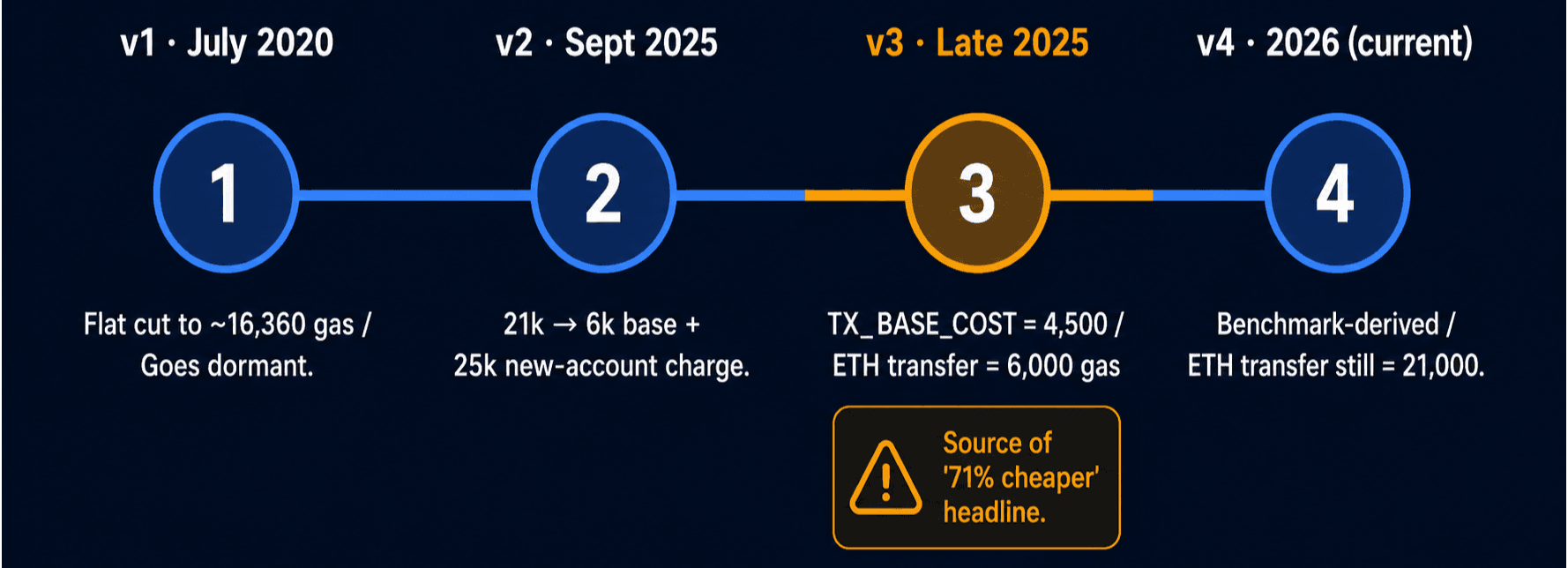
Version 3 is the one that generated the "up to 71% cheaper" headline because a plain ETH transfer would have cost 6,000 gas. The current canonical Version 4 keeps the existing-account ETH transfer total at 21,000 because the benchmark-fitted primitives happen to sum to that figure. The spec is now called "Resource-based intrinsic transaction gas."
How does the current specification work?
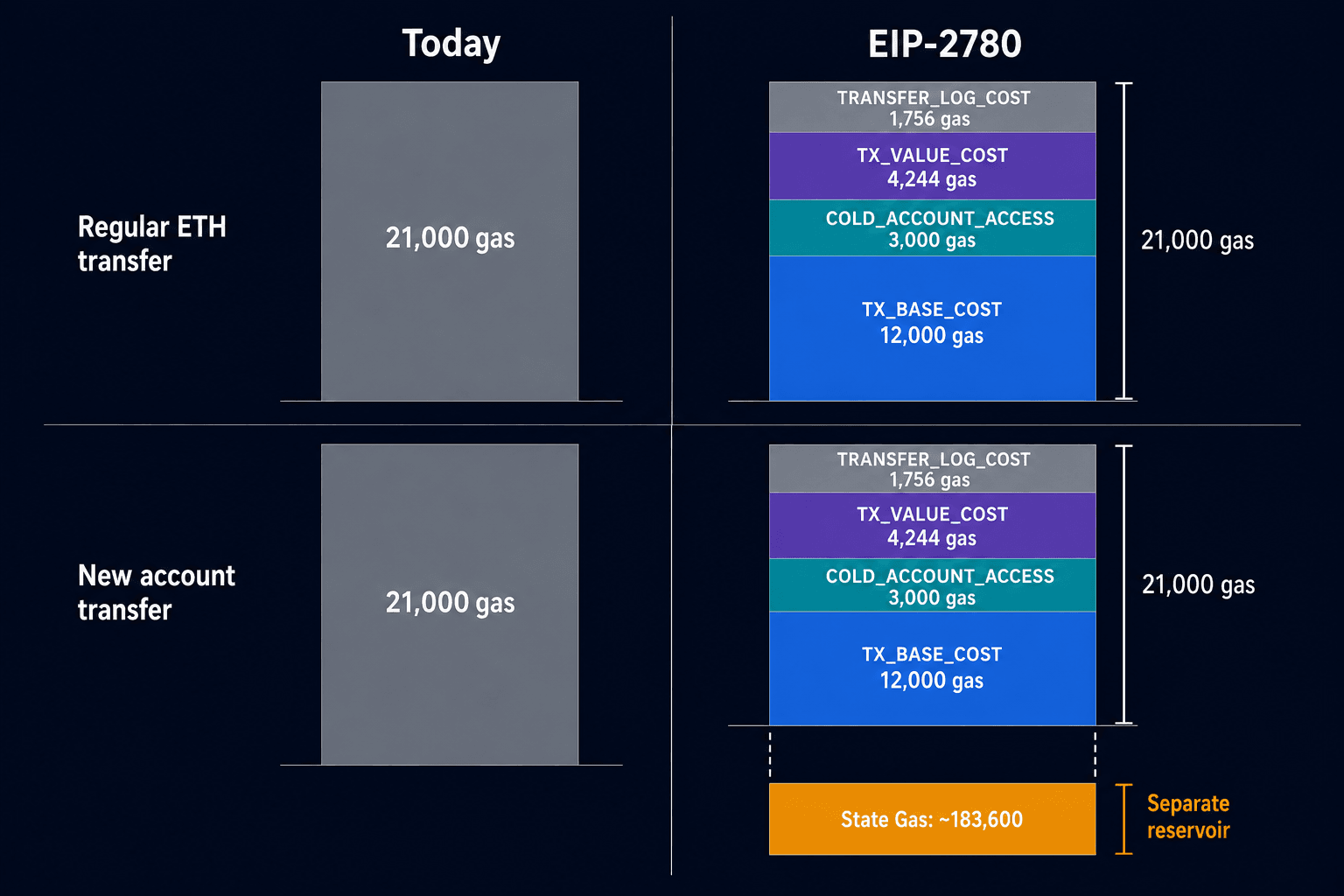
The spec decomposes 21,000 into four named parameters, each derived from NNLS regression of measured client runtimes across all five major execution clients (Besu, Erigon, Geth, Nethermind, Reth), anchored at 100,000 gas per millisecond of CPU time:
| Parameter | Gas | What it pays for |
|---|---|---|
| TX_BASE_COST | 12,000 | ECDSA recovery, sender account read + write |
| COLD_ACCOUNT_ACCESS | 3,000 | Reading the recipient account (always cold at tx level) |
| TX_VALUE_COST | 4,244 | Writing the recipient's balance |
| TRANSFER_LOG_COST | 1,756 | The EIP-7708 transfer log |
TX_BASE_COST (12,000) + COLD_ACCOUNT_ACCESS (3,000) + TX_VALUE_COST (4,244) + TRANSFER_LOG_COST (1,756) = 21,000. Same headline, different anatomy.
The spec also inherits a two-dimensional gas model from EIP-8037: regular gas for computation, and state gas for permanent storage growth. Account-creating transfers pay 21,000 regular gas plus ~183,600 state gas from a separate reservoir.
Reference costs by transaction type:
| Transaction type | Regular gas | State gas |
|---|---|---|
| Self-transfer | 12,000 | 0 |
| Zero-value call to existing account | 15,000 | 0 |
| ETH transfer to existing EOA | 21,000 | 0 |
| ETH transfer creating a new account | 21,000 | ~183,600 |
| Contract creation, value > 0 | 24,756 | ~183,600 |
EIP-2780 imports COLD_ACCOUNT_ACCESS from EIP-8038 and the state-byte cost from EIP-8037, so future repricings of those parameters automatically flow through to intrinsic gas. The spec also has explicit rules for EIP-7702 delegated accounts: a value transfer to a 7702-delegated address costs 24,000 regular gas.
What does this change for users, wallets, and L2s?
Ordinary users: Plain ETH transfers between existing accounts are unchanged at 21,000 gas. Zero-value calls get cheaper (15,000). Sending to a fresh address gets more expensive because of the state-gas charge. If you regularly send to new counterparties or run airdrops, expect higher costs.
Wallet developers and gas estimators: This is the most operationally significant change. Any tool that hard-codes a flat 21,000 intrinsic base must be updated. More importantly, the two-dimensional gas model means a transaction's state-gas cost can dwarf its regular-gas cost: ~183,600 state gas versus 21,000 regular gas for a new-account transfer. Begin modeling this now. The trigger to act is EIP-2780 moving from CFI to SFI on EIP-7773.
L2s and rollups: The direct effect is modest since the dominant levers remain blob and calldata pricing. The indirect benefit is that cheaper zero-value transactions reduce fixed overhead on batched operations, and accurate account-creation pricing prevents mispriced state-growth transactions from being undercharged in L2 batches. For Rango, we are tracking EIP-7773 closely and will update our gas estimation engine ahead of any Glamsterdam devnet activation. You can swap and bridge across 80+ chains today on Rango Exchange.
Where does EIP-2780 stand today?
EIP-2780 was moved to Considered for Inclusion at ACDE #226 on December 18, 2025. As of June 2026, it is CFI but not SFI. The Reth team rates it "Tier 1: High Priority." Erigon, Reth, and Besu developers have publicly supported evaluating it, and the EF research team backs the full repricing bundle. The key technical gating condition is all five major execution clients meeting the 100 Mgas/s benchmark on the heaviest transfer path (unique 24-KiB-code receiver).
The main open risks are: spec ambiguity on edge cases flagged by Jochem Brouwer on Etheruem Magicians; the 2300-stipend interaction in corner cases; and a process concern that the broader repricing bundle is "too monolithic." Watch the bi-weekly Glamsterdam Repricings call series and the EIP-7773 hardfork meta for updates.
Conclusion
EIP-2780 replaces Ethereum's 2014 flat intrinsic gas constant with four empirically grounded primitives and internalizes the real cost of state creation. The headline number for a standard ETH transfer stays at 21,000, but the components behind it finally have a measurable justification. For developers and infrastructure teams, the practical takeaway is straightforward: stop assuming a flat 21,000 base, start modeling two gas dimensions, and watch for EIP-2780's graduation from CFI to SFI.
Resources
Frequently asked questions
Check out most commonly asked questions, addressed based on community needs. Can't find what you are looking for?
Contact us, our friendly support helps!
Does EIP-2780 make ETH transfers cheaper?
It depends on the type. A standard ETH transfer between two existing accounts costs 21,000 gas in the current version, same as today. Zero-value calls drop to 15,000 gas and self-transfers to 12,000 gas. Transfers to brand-new addresses become more expensive due to the ~183,600 state-gas charge. The "71% cheaper" claim comes from an earlier intermediate draft that has since been redesigned.
When will EIP-2780 go live?
EIP-2780 is Considered for Inclusion in Glamsterdam, which targets mid-to-late 2026. CFI is not the same as Scheduled for Inclusion. As of June 2026, EIP-2780 has not been confirmed for the fork and its inclusion depends on completing the testing burndown and on Glamsterdam's headliner EIPs landing on schedule. Follow the EIP-7773 hardfork meta for live status.
How does Rango Exchange handle the two-gas-dimension model EIP-2780 introduces?
EIP-2780 inherits a two-dimensional gas model from EIP-8037, where regular gas and state gas are separate reservoirs. For Rango's routing engine, gas estimation for Ethereum mainnet transactions will need to account for both dimensions once EIP-2780 is active. We are monitoring the Glamsterdam devnet series and will update our gas models ahead of mainnet activation.